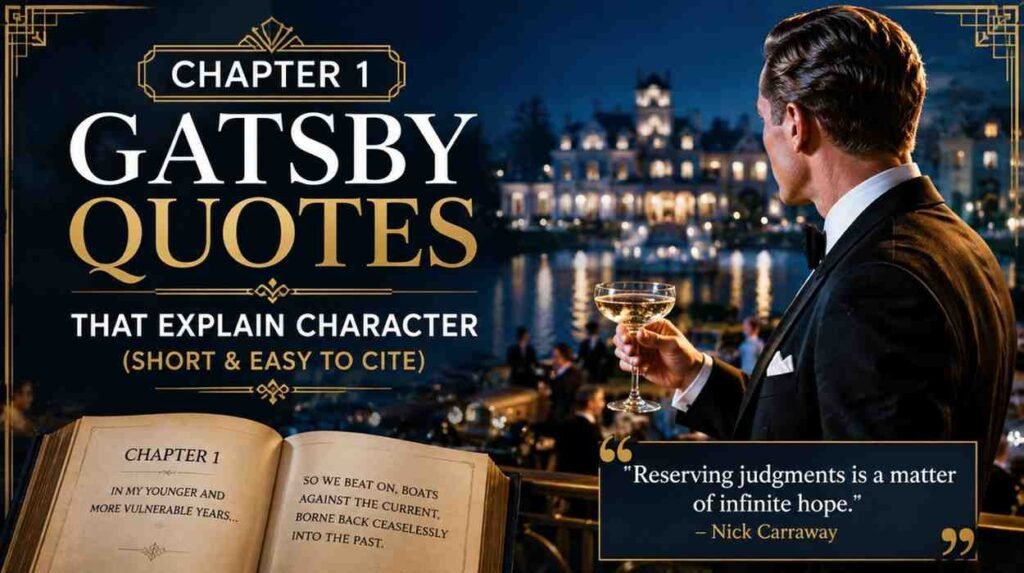
Chapter 1 Gatsby Quotes : The clearest character-revealing quote in Chapter 1 is Nick Carraway’s self-description: “I’m inclined to reserve all judgments.” It’s short, it’s quotable, and it immediately sets up one of the novel’s central ironies — Nick claims to be nonjudgmental, but spends the rest of the book judging almost everyone he meets.
Chapter 1 of The Great Gatsby does a lot of quiet character work before Gatsby himself even properly appears — and if you’re hunting for short quotes that explain character rather than long descriptive passages, this guide sorts them for you. Below, the chapter’s best character-revealing lines are grouped by who they’re about, with a quick explanation of what each one tells you. (One quick note: The Great Gatsby entered the U.S. public domain in 2021, so these lines can be freely quoted and cited.)
Chapter 1 Gatsby Quotes
Nick is the novel’s narrator, and Chapter 1 spends real time establishing — and quietly undercutting — how he sees himself.
- “In my younger and more vulnerable years, my father gave me some advice that I’ve been turning over in my mind ever since.” What it reveals: The novel’s famous opening line frames Nick as reflective and shaped by inherited values — setting up the “reserving judgment” idea before he even states it directly.
- “I’m inclined to reserve all judgments.” What it reveals: Nick presents himself as fair and open-minded. The irony builds as the novel goes on — Nick judges nearly every character he meets, often quite harshly, despite this claim.
- “Whenever you feel like criticizing anyone, just remember that all the people in this world haven’t had the advantages that you’ve had.” What it reveals: This is Nick recalling his father’s advice, and it establishes his awareness of class privilege early — a theme that runs through the entire novel.
- “I was privy to the secret griefs of wild, unknown men… most of the confidences were unsought.” What it reveals: Nick positions himself as the kind of person people naturally confide in — a trait that becomes essential to the plot, since Gatsby, Tom, and others all end up trusting him with secrets.
Chapter 1 Gatsby Quotes Short Daisy Buchanan Quotes
Daisy’s introduction is all charm on the surface, with cracks showing almost immediately underneath.
- “I’m p-paralyzed with happiness.” What it reveals: Daisy’s exaggerated, theatrical way of speaking suggests performance rather than sincerity — a trait that defines her character throughout the novel.
- “I hope she’ll be a fool — that’s the best thing a girl can be in this world, a beautiful little fool.” What it reveals: Said about her infant daughter, this is Daisy’s bleakest, most self-aware line in the chapter — a cynical acknowledgment that intelligence and awareness haven’t brought her happiness in a world that limits women’s choices.
- “You see I think everything’s terrible anyhow… And I know. I’ve been everywhere and seen everything and done everything.” What it reveals: Beneath the glittering surface, Daisy admits to a kind of exhausted disillusionment — hinting at a deeper unhappiness she mostly keeps hidden behind charm.
Also Read – Compassionate Quotes: The Best Lines on Kindness and Understanding
Chapter 1 Gatsby Quotes Short Tom Buchanan
Tom’s very first lines establish him as blunt, physically imposing, and casually cruel.
- “Now, don’t think my opinion on these matters is final… just because I’m stronger and more of a man than you are.” What it reveals: Tom’s need to assert physical dominance, even in casual conversation, reveals his insecurity dressed up as confidence.
- His dinner-table rant about a racist pseudo-scientific book, delivered with total sincerity while everyone else at the table is visibly uncomfortable. What it reveals: Fitzgerald uses this moment to establish Tom’s bigotry and intellectual pretension immediately — Daisy even mocks him for it, showing the family tension underneath the wealth.
Chapter 1 Gatsby Quotes Short Jordan Baker
Jordan gets less dialogue than the others in Chapter 1, but Nick’s descriptions of her do most of the character work.
- Nick’s observation that Jordan holds herself with a certain “discontented” boredom, barely masked by good manners. What it reveals: Jordan is established early as detached and self-possessed — someone performing ease rather than actually being at ease, which fits her later characterization as dishonest and unbothered by it.
Chapter 1 Gatsby Quotes Short Gatsby-Related
Gatsby himself barely appears in Chapter 1, but the descriptions around him are doing careful setup work.
- Nick’s description of Gatsby’s mansion as a “colossal affair,” an imitation of a French hotel de ville with a “thin beard of raw ivy.” What it reveals: The mansion’s showy scale paired with its “new,” unweathered ivy hints at new money trying to look like old money — a tension that defines Gatsby’s whole character.
- Nick’s closing description of Gatsby at the end of the chapter, alone on his lawn, reaching toward a single green light across the water. What it reveals: This is the chapter’s most quietly important image — introducing Gatsby not through dialogue, but through longing, isolation, and a symbol (the green light) that will carry meaning for the rest of the novel.
FAQs
What do we learn about Nick Carraway in Chapter 1?
Nick presents himself as tolerant and nonjudgmental, shaped by his father’s advice about privilege, and establishes himself as the kind of person others naturally confide in — traits that become central to how the story gets told.
What is Daisy’s most famous quote in Chapter 1?
Her line “I hope she’ll be a fool — that’s the best thing a girl can be in this world, a beautiful little fool,” said about her daughter, is the chapter’s most quoted and most analyzed line.
What does Tom Buchanan’s introduction reveal about his character?
Tom is introduced as physically imposing, casually arrogant, and openly bigoted, especially through his enthusiastic embrace of a racist pseudo-scientific book at the dinner table.
What is the first line of The Great Gatsby?
The novel opens with: “In my younger and more vulnerable years, my father gave me some advice that I’ve been turning over in my mind ever since.”
Is The Great Gatsby in the public domain?
Yes. The novel entered the U.S. public domain on January 1, 2021, meaning its text can be freely quoted, reproduced, and adapted without copyright restriction in the United States.
What does the green light symbolize in Chapter 1?
The green light, seen across the water at the end of Chapter 1, represents Gatsby’s longing and hope — most directly tied to his feelings for Daisy, and more broadly to the unreachable nature of the American Dream.